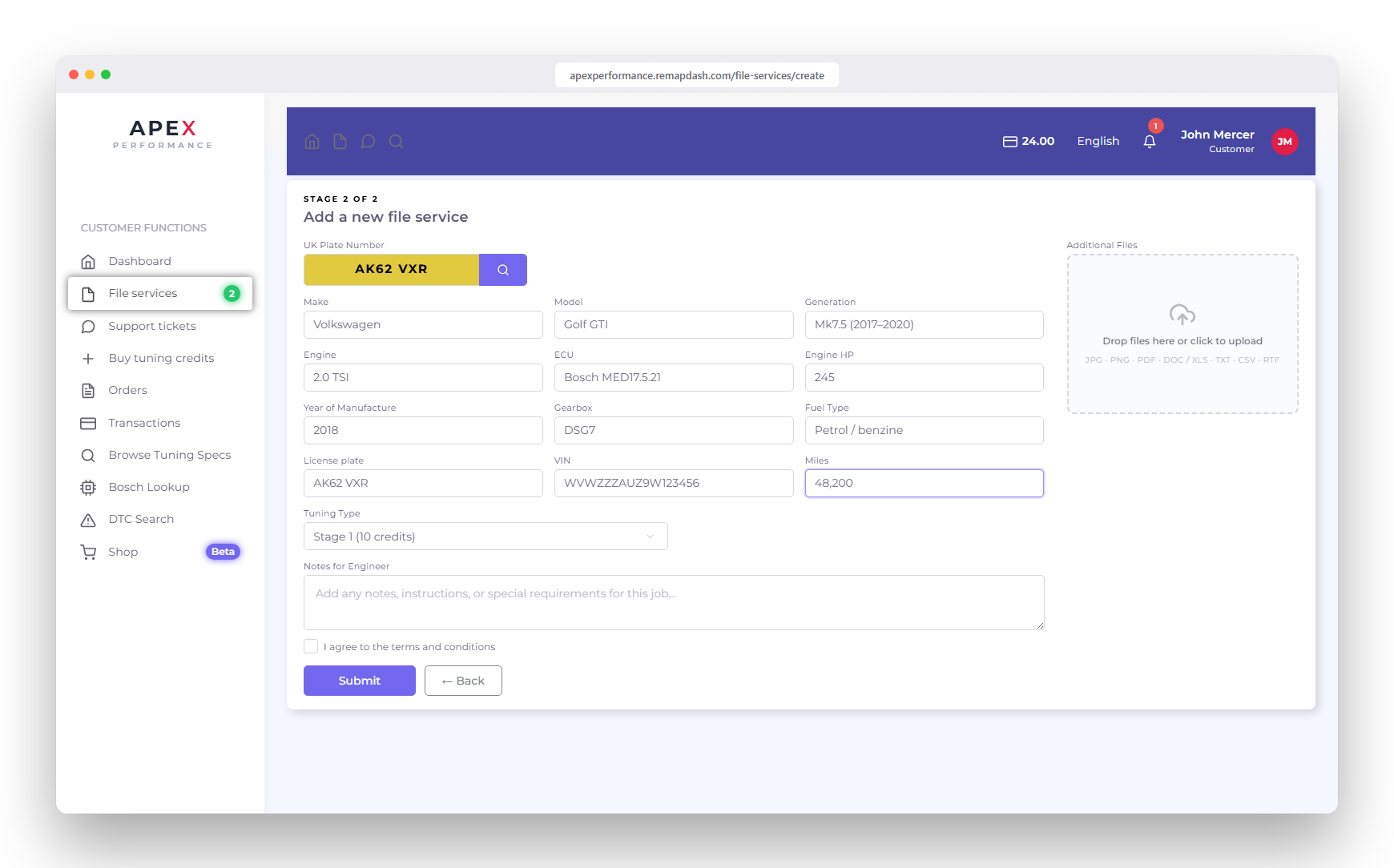
They type a reg plate. The rest fills itself in.
Every job needs to know exactly what the car is. Most portals make somebody type that out, and somebody types it wrong. RemapDash resolves the vehicle from a UK registration plate or a VIN at the moment of submission — make, model, engine, fuel, year — so the job arrives correct. Unlimited lookups, no daily cap, no per-query charge.
The real cost of a retyped vehicle
On the surface this is a convenience feature. Nobody enjoys typing "1.6 TDI CR 105bhp" into a form. But convenience is the least interesting thing about it, and the shops that understand why tend to be the ones with the best-run benches.
Consider what happens when vehicle data is typed by hand. A dealer submitting from a phone, in a workshop, mid-job, types what he thinks the car is. Sometimes that is the model on the tailgate rather than the engine variant. Sometimes it is the previous customer's car because the form was half-filled already. Sometimes it is "Golf 2.0" for a car that could be one of half a dozen quite different calibrations. Sometimes it is simply a typo.
You then do one of three things, and all three are expensive:
- You ask. A message goes back, the dealer is under a car, an hour passes. The job is stalled on a question that should never have needed asking.
- You work it out. You infer the real vehicle from the file, which you are good at — but it is unpaid detective work, repeated daily.
- You accept it. The wrong description goes into the job, and therefore into your records, and it is wrong forever.
The third one is the genuinely costly outcome, because it is invisible today and expensive later. Which brings us to the part of this feature that nobody markets.
Reg plate lookup: the customer's side gets easier
In the UK, the registration plate is the natural key. Everybody knows it, it is on every job sheet and every text message, and a dealer can read it off the car in two seconds without opening a door.
So the submission form starts there. The customer types the reg, and the make, model, engine, fuel type and year populate themselves. What was a form full of fields the customer would rather not fill in becomes a single box and a confirmation.
Two things follow, and the second matters more than the first:
- Submission gets faster, which sounds like a customer perk and is actually a commercial one. The easier it is to send you a job, the more jobs get sent. Friction at intake is friction on your revenue.
- The data is right, because it came from the vehicle record rather than from somebody's memory. Not "probably right" — sourced.
It also changes the tone of the relationship. A dealer submitting to a portal that already knows the car feels like they are dealing with a professional operation. A dealer typing engine variants into a bare form feels like they are doing your admin for you. Over a year of jobs, that impression is worth more than most marketing.
Unlimited means unlimited
This is worth stating plainly because the industry has trained people to expect otherwise. Reg lookups on RemapDash are not capped per day and not charged per query. Look up a hundred in an afternoon, look up the same car six times while a dealer works out what he is sending — it does not matter, and it does not generate a bill.
Competing platforms commonly limit lookups per day or charge per query, which produces the absurd situation where a tuner is rationing the single cheapest thing that makes their data accurate. A capped lookup is worse than no lookup, because the day you hit the cap is the day people start typing again — and your records go back to being guesses without anybody deciding that.
VIN lookup: for everything the plate cannot answer
The reg plate is the fastest route in, but it is not always the right one, and it is not always available. VIN lookup covers the rest:
A VIN is the vehicle's own identity, stamped by the manufacturer, and it is the closest thing to ground truth available at intake. Where a plate gives you the registered vehicle, the VIN gives you the specific one.
The two are complementary rather than competing: the plate for speed on the majority of UK jobs, the VIN for certainty on the awkward ones. Used together they cover almost everything that walks through the door.
- Imports and personal plates, where the registration tells you less than you would like about what the car actually is.
- Bench and boot jobs, where an ECU is on the bench and the car is not present — sometimes not even in the same country.
- Non-UK vehicles, where there is no UK registration record to query at all.
- Disagreements, where what the customer says the car is and what the file suggests do not match, and you want a third source before you commit.
What clean intake data actually buys you
Pulling the threads together, because the individual benefits undersell the compound one:
- Fewer stalled jobs. The "what car is this actually?" message round-trip mostly disappears, and with it an hour of dead time per affected job.
- Faster, more accurate quoting. Knowing the exact engine variant up front means pricing and expectations are right the first time.
- A searchable library that stays searchable. Accurate producer, model and engine data on every job is what lets you find the right past file in five seconds — in eighteen months, when you have forgotten the job entirely.
- Donor matching that works. Library-based automation is only as good as the library. Correct vehicle data at intake is a precondition for automation being useful later, not a separate nicety.
- Records that hold up. If a customer, an insurer or a warranty assessor ever asks what you worked on, "this exact vehicle, sourced from its own record" is a much better answer than a typed description.
- A professional front door. Every dealer who submits a job sees a system that knows the car before they have finished typing.
Frequently asked questions
Does any tuning file portal have UK reg plate lookup built in?
Yes. RemapDash includes UK registration plate lookup at the point a customer submits a job — the customer types the reg and the make, model, engine, fuel type and year populate automatically. Lookups are unlimited, with no daily cap and no per-query charge, and are included in the flat monthly fee rather than sold as an add-on.
Can a tuning portal look up a vehicle by VIN?
Yes. VIN lookup is included alongside reg plate lookup. It covers the cases a registration cannot: imports, personal plates, non-UK vehicles, and bench or boot jobs where the ECU is present but the car is not. The plate is the fastest route for most UK jobs; the VIN gives certainty on the awkward ones.
Are reg plate lookups limited or charged per query?
Not on RemapDash. Lookups are unlimited with no daily cap and no per-query cost. Competing platforms commonly cap lookups per day or charge per query, which leads to tuners rationing lookups and going back to typing vehicle data by hand — which is how job records become inaccurate.
Why does accurate vehicle data at intake matter for tuning?
Because a tuner's project library is only valuable if it is searchable, and it is only searchable if the vehicle, engine and ECU data on every past job is correct. Vehicle details typed by hand on a phone introduce errors that are invisible on the day and expensive years later, when the right past file cannot be found. Accurate intake data is also a precondition for library-based donor matching and automation to work at all.
Does reg lookup speed up submitting a job for the customer?
Yes, significantly. A form full of vehicle fields becomes a single box: the customer types the registration and confirms. That lowers the friction of sending work, which in practice means more jobs submitted — and every field the customer does not have to type is a field they cannot get wrong.
What if the vehicle has a personal plate or is an import?
That is what VIN lookup is for. Where a registration record is missing, unhelpful, or does not reflect the actual vehicle specification, the VIN identifies the specific vehicle as built. Both lookups are available on every job.
Go deeper
- Automatic slave file decoding & encoding — AutoTuner and KESS3 files decoded before you open the job.
- Archive support — zipped submissions unpacked natively, finished work zipped for return.
- the WinOLS automation bot — why clean library data is what makes automation possible.
- What tuning file portal software does — the whole picture around the bench.
Stop typing what the car already knows.
Unlimited reg and VIN lookup, automatic slave decode, native archive handling, WinOLS LUA bot, branded portal, mobile app and invoicing — £74.50 /month for your first 6 months, then one flat £129 /month. No per-file charges, no lookup caps, no contract.